What Are Ear Mites?
Ear mite infections in dogs are caused by a microscopic parasite called Otodectes cynotis. This tiny parasite colonizes the external ear canal of dogs, where it feeds on earwax, dead skin cells, and skin secretions.
Ear mites reproduce extremely quickly. Their entire life cycle takes roughly three weeks, which is why an ear mite infection can rapidly worsen if left untreated. The parasites spread primarily through direct contact from one animal to another.
Although they occur in dogs, they are even more common in cats. In fact, many dogs catch ear mites from an infected cat.
How Do Dogs Get Ear Mites?
The most common way a dog contracts ear mites is through direct contact (sharing a bed, playing) with an infected animal.
Particularly at risk are:
- puppies (due to their developing immune systems),
- dogs coming from animal shelters,
- dogs that frequent dog parks or training classes,
- pets in multi-pet households (especially those with cats).
Ear mites can also survive for a short period in the environment without a host, meaning pet beds, blankets, and grooming brushes can also play a role in spreading the infection.
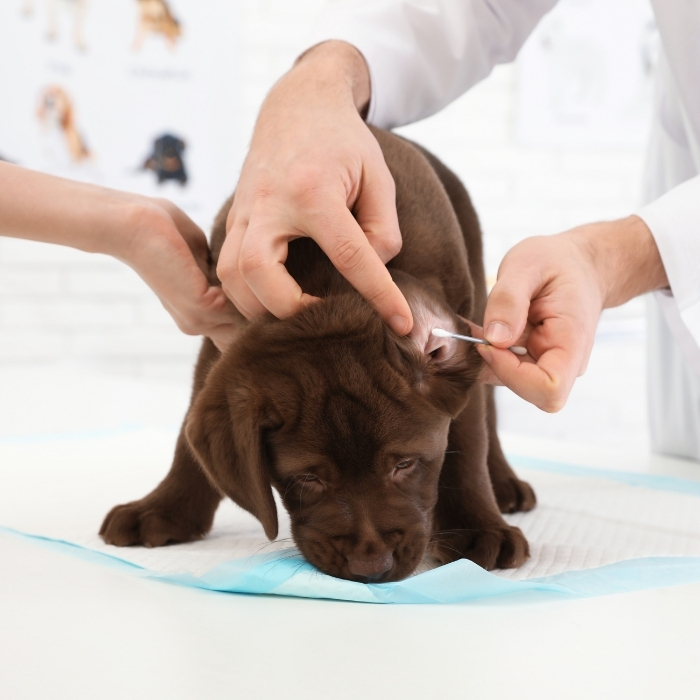
Ear mite infection is a common problem in puppies.
Common Symptoms of Ear Mite Infections in Dogs
Ear mites cause intense irritation in the ear canal, so the symptoms are usually noticed quickly. As an owner, if you observe the following symptoms in your dog, you should suspect the presence of ear mites:
- Intense ear scratching: The dog constantly scratches its ears or rubs its head and ears against furniture.
- Head shaking: Frequent, forceful head shaking is a classic warning sign.
- Dark brown or black discharge: This is one of the most telling symptoms. The infected ear develops a characteristic crumbly discharge that resembles "coffee grounds." This is a mix of earwax, mite feces, and dried blood.
- Unpleasant odor: Infected ears often emit a strong, sweetish, or musty odor.
- Red, inflamed ears: Due to constant irritation, the ear canal and ear flap (pinna) may appear red and tender.
- Wounds and hair loss: Continuous scratching can lead to small lesions, scabs, and hair loss around the ears.
- Other symptoms: In more severe cases, loss of balance or a head tilt may also occur.
Ear Mites or Other Ear Infections:
What’s Behind the Symptoms?
Ear problems in dogs often present with very similar symptoms (scratching, head shaking, discharge), making it difficult at first glance to tell whether you are dealing with ear mites, a bacterial or yeast infection, or another underlying issue. The following guidelines can help narrow down your suspicions, but an accurate diagnosis always requires a veterinary examination.
🟤 Suspect Ear Mites if:
- The discharge is dark brown or black and crumbly ("coffee grounds"). This is the classic ear mite symptom: a mixture of earwax, mite feces, and skin debris gives it this distinctive, dry, granular texture.
- The itching is intense (the dog scratches almost constantly). Ear mites trigger a strong allergic reaction and continuous irritation, so the dog often "cannot stop" scratching.
- Both ears are affected. Ear mites easily spread from one ear to the other, so they are often present in both ears rather than just one.
- The dog shakes its head a lot. Head shaking is a common response to constant irritation, offering the dog temporary relief.
- Multiple pets are scratching in the household. Ear mites are highly contagious, so if there are multiple dogs or cats in the home, all of them may be affected.
- The dog is young or recently rescued from a shelter. Ear mite infections are more common in puppies and animals coming from group environments due to close contact.
Key Takeaway: Classic ear mite residue is dry and granular, not wet or purulent (pus-filled).
🔴 It is more likely a Bacterial Ear Infection if:
- A wet, purulent (pus-like), or yellowish-green discharge is coming from the ear. This typically points to a bacterial infection, as bacteria produce inflammatory fluid.
- There is a very strong, foul odor coming from the ear.
- The ear is painful, and the dog does not allow you to touch it. Bacterial inflammation is deeper and more painful than an ear mite infestation.
- The inflammation is often unilateral (only one ear is affected). This is frequently caused by a localized infection or a foreign body (such as a foxtail/grass awn) trapped in the ear.
- The condition of the ear deteriorates rapidly. Visible worsening can occur within just a few days.
🟡 It is more likely a Yeast Infection (Malassezia) if:
- A greasy, brownish, waxy discharge comes from the ear. An overgrowth of yeast typically creates an oily, salve-like buildup. The inside of the ear may appear sticky, and the discharge feels greasy to the touch.
- The ear has a distinct sweetish, musty, yeast-like odor.
- The problem is chronic, long-standing, or recurring.
- There is an underlying food allergy or environmental allergy.
🟢 Foreign Object in the Ear: A Common, Easily Confused Issue
A foreign object trapped in a dog’s ear—such as a foxtail (grass awn), blade of grass, sand, or small plant fragment—can cause symptoms very similar to an ear infection or ear mites.
A foreign object is likely if:
- symptoms appear suddenly,
- the dog shakes its head very intensely,
- only one ear is affected,
- the dog whines or exhibits clear signs of pain,
- the complaints started after a walk, running in a field, or tall grass,
- the dog constantly holds its head to one side.
Foxtails are especially dangerous because they can work their way deeper into the ear canal, causing severe inflammation or even a ruptured eardrum. Home removal is not recommended, as you may push the foreign body even deeper.
If your dog exhibits severe head shaking or sudden onset of one-sided ear pain, consult a veterinarian as soon as possible.
Important Rule
The symptoms above can only point to a suspicion; a definitive diagnosis can only be made through a veterinary examination. These conditions are easily confused and frequently occur together: an ear mite infection often leads to a secondary bacterial or yeast infection.
Be Sure to Consult a Veterinarian:
- If your dog's condition does not improve within 2–3 days. Ear problems rarely resolve on their own.
- If the dog shows signs of pain. This indicates more severe inflammation.
- If foul-smelling or purulent discharge is coming from the ear.
- If severe head shaking or balance issues occur. This may signal a more serious, deeper ear infection that requires urgent care.
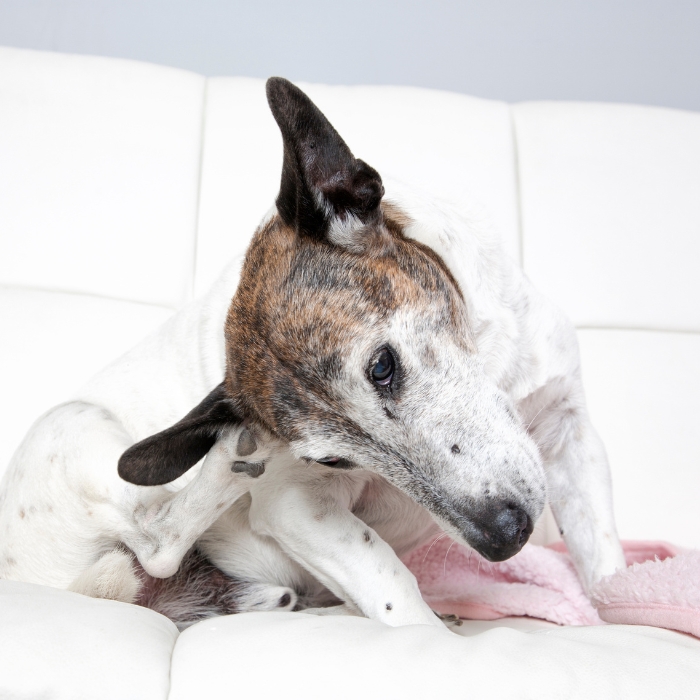
Intense ear scratching, along with dark brown or black, crumbly, "coffee ground-like" discharge, are clear signs of an ear mite infection.
Why Is a Veterinary Examination Important?
There are many potential underlying causes for ear scratching and inflammation; identifying the exact cause(s) is a job for a professional. The veterinarian will inspect the ear with an otoscope and take a sample of the discharge to examine under a microscope. A precise diagnosis is crucial because certain ear drops cannot be used if the eardrum is damaged, and the choice of ear drop depends entirely on the root cause of the problem.
How Are Ear Mites Treated?
- Ear Cleaning: The first step in treatment is almost always a thorough cleaning of the ear canal. Accumulated discharge and wax can block medications from working effectively. A vet-
- recommended ear cleaning solution helps dissolve debris and reduces irritation.
- Medical Treatment: Modern veterinary treatments are extremely effective. Treatment can be administered via:
- ear drops,
- spot-on treatments,
- oral tablets,
- or, less frequently, injections.
Many modern flea and tick preventatives also provide protection against ear mites. Treatment must always be continued for the full duration prescribed, even if symptoms improve quickly; otherwise, mites can re-emerge from remaining eggs.

Diagnosing an ear mite infection is the responsibility of a veterinarian.
Should Other Pets in the Household Be Treated too?
If you have multiple dogs or cats living together, all animals in the household must be treated, even if they show no symptoms. Ear mite infections spread very easily, and asymptomatic pets can still act as carriers.
For treatment to be successful, treating only the dog’s ears is not enough.
It is recommended to:
- wash pet beds and blankets in hot water,
- disinfect grooming brushes and toys,
- thoroughly clean and disinfect the dog’s living area and any surfaces it came into contact with at home.
All of this is essential to reduce the chances of reinfection.
What Happens If an Ear Mite Infection Is Left Untreated?
An untreated ear mite infection is not only uncomfortable, but it can also be dangerous.
Potential complications are severe and can be permanent:
- severe otitis externa (outer ear inflammation),
- secondary bacterial or yeast infections,
- damaged eardrum,
- aural hematoma (a blood blister on the ear flap caused by violent scratching/shaking),
- chronic pain,
- hearing loss.
The longer treatment is delayed, the more difficult and costly recovery can become.
Are There Effective Home Remedies for Ear Mites?
There are many home remedies circulating online—such as using olive oil, vinegar, or tea tree oil.
However, the vast majority of veterinarians do not recommend these because:
- they do not reliably kill all mites,
- they can cause skin irritation,
- they can exacerbate inflammation,
- they delay proper veterinary treatment.
Tea tree oil, for example, can be toxic to dogs in certain amounts.
How Can Ear Mites Be Prevented?
- Regular ear inspections: Check your dog's ears once a week for unusual odors, discharge, redness, or excessive earwax.
- Proper ear hygiene: Not all dogs need regular ear cleaning, but for breeds prone to ear mites and infections, routine cleaning with an antibacterial, wax-dissolving ear care solution can be beneficial.
- Parasite protection: Many modern spot-on or tablet preventatives provide effective protection against ear mites as well.
- Avoid infected animals: If another animal is visibly scratching its ears or has heavy discharge, avoid direct contact.
Facts and Myths About Ear Mites
- "Ear mites only occur in neglected dogs": False. Ear mite infections have nothing to do with how attentive an owner is. Any dog can contract them.
- "It will go away on its own": False. Ear mites will not go away without treatment.
- "Cleaning the ear is enough": False. Cleaning is essential, but cleaning alone will not eradicate the mites.
- "Humans can easily catch them": False. Transmission to humans is rare, and these mites are generally unable to survive or colonize human skin long-term.
Our article is for informational purposes only and is not a substitute for a veterinary examination or treatment. For an accurate diagnosis and appropriate therapy, please consult your veterinarian!
 Spend at least 25,000 HUF and enjoy
 For our human health products, visit our
